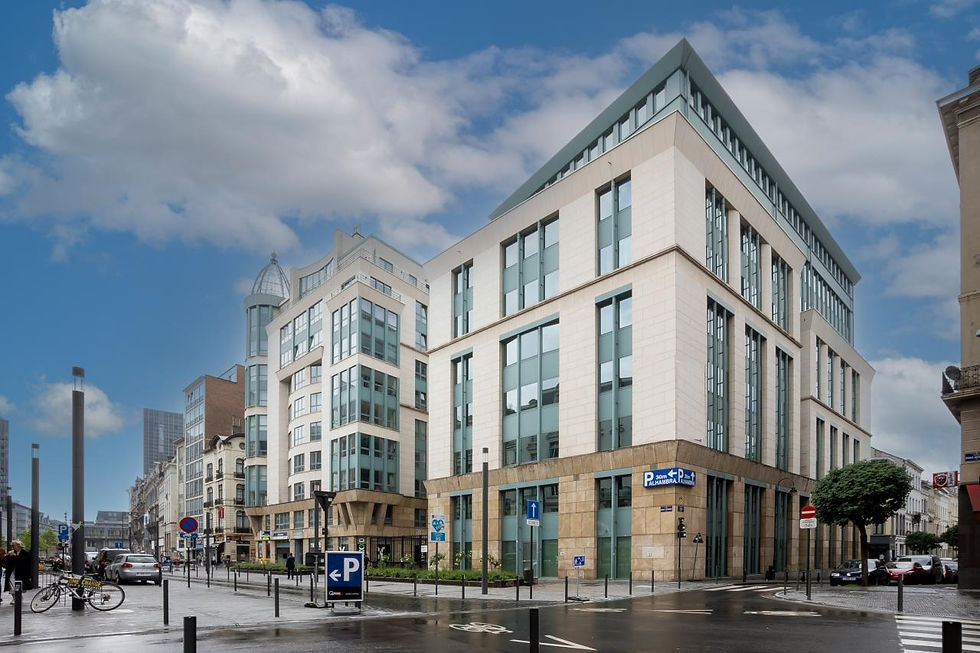
Coworking or a private office: Which option should you choose for your business in Brussels?

Choosing Your Offices: A Strategic Decision for Your Company's Growth
When a company decides to rent a office in Brussels or move to new premises, the choice of workspace goes beyond a simple question of size or budget. Offices are a true development tool. They influence the company's image, the well-being of employees, the ability to attract new talent, and even the perception that clients and partners will have during their visits.
For several years, the commercial real estate market has been rapidly evolving. Remote work, new employee expectations, environmental requirements, and the search for more flexibility have profoundly transformed the needs of businesses. Today, leaders no longer choose solely between renting or buying an office. They must also determine whether a coworking space, an operated office, or a traditional private office better suits their organization.
In Brussels, this reflection is even more important as the offering is particularly diverse. Neighborhoods like Avenue Louise, the European Quarter, Brussels North, or the Pentagon offer very different solutions in terms of both price and services. Some companies prioritize the flexibility of shared space in brussels, while others seek primarily confidentiality and a strong brand image through fully customized offices.
There is therefore no universal answer. The best choice depends on many criteria: the size of your team, your industry, your growth prospects, your budget, but also your daily working style.
Mesh-immo guides you step by step to understand the differences between coworking and private offices. You will discover their advantages, limitations, respective costs, and the situations in which each solution is most relevant.
Why the Choice of Your Offices is More Important Than It Seems
For a long time, offices were seen as a mere real estate expense. Today, they have become a true performance lever.
The most successful companies pay special attention to their work environment, as it directly influences employee motivation. Bright premises, easily accessible by public transport, and adapted to new working methods contribute to improving the daily comfort of teams. Conversely, poorly located or non-functional offices can quickly become a barrier to recruiting and retaining talent.
The image projected to clients also plays an essential role. Receiving a prospect in a modern building located on Avenue Louise or in the European Quarter does not have the same impact as a meeting organized in a poorly suited space. For many companies, offices fully participate in their communication strategy and enhance their credibility.
The choice of premises must also take into account the future evolution of the company. A start-up with four people today may have fifteen employees in two years. Conversely, some companies now prioritize hybrid work and seek more compact, better-optimized, and easily modifiable spaces.
Finally, financial aspects should not be overlooked. Beyond rent, it is important to evaluate charges, renovation costs, furniture, IT equipment, energy consumption, and any necessary work before moving in. A solution that seems less expensive at first glance may ultimately represent a larger investment over several years.
Taking the time to analyze these different elements helps avoid many mistakes and opt for a solution that is truly adapted to the company's objectives.
What is a Coworking Space?
Coworking spaces have established themselves as a new way of working. Initially intended for freelancers and independent professionals, they now welcome start-ups, SMEs, international subsidiaries, and even large companies seeking greater flexibility.
In practice, a coworking space provides companies with workstations or private offices in a shared environment. Occupants benefit from a fully equipped infrastructure that generally includes furniture, high-speed internet, meeting rooms, relaxation areas, a communal kitchen, and sometimes even additional services such as reception, business domiciliation, or the organization of professional events.
In Brussels, coworking is experiencing particularly significant growth. The main business districts now concentrate many operators offering very varied packages, ranging from simple nomadic workstations to private offices that can accommodate several dozen employees.
This model particularly appeals to companies that want to avoid the constraints of a traditional lease. Contracts are generally much more flexible and allow for quick adjustments to the occupied space based on business activity changes. A company that is hiring new employees can thus increase the number of workstations without having to move or engage in renovation work.
Coworking also offers almost immediate activation. Unlike a traditional office, which often requires several weeks of preparation, a shared space is ready to be used as soon as the contract is signed. This speed is a significant advantage for companies that need to set up quickly or open a new branch in Brussels.
The Advantages of Coworking
One of the main advantages of coworking lies in its great flexibility. Companies can rent a workspace for a few days, a few months, or several years, without being tied down by a long-term commercial lease. This flexibility is particularly appreciated by startups, consultants, or rapidly growing companies whose needs evolve quickly.
Coworking also allows for cost control. Most expenses are included in the price: Internet, heating, electricity, maintenance, cleaning, furniture, and sometimes even coffee or printing. Companies thus avoid many initial investments and have better visibility over their monthly expenses.
Another often underestimated advantage is the time savings. Since the premises are fully furnished, teams can start working immediately. No construction, no ordering of furniture, and no complex IT installations are required. This administrative simplicity allows leaders to focus entirely on developing their business.
Coworking spaces also encourage exchanges between professionals. The companies present often belong to various sectors, creating an environment conducive to sharing experiences, developing partnerships, and creating new business opportunities. Many operators regularly organize conferences, training sessions, or networking events that enhance this community dynamic.
Finally, coworking often offers prestigious locations that would be difficult to access through traditional leasing. Setting up a business on Avenue Louise, in the European Quarter, or in North Brussels thus becomes more affordable while benefiting from a valuable address for clients and partners.
The Limitations of Coworking: A Solution Not Suitable for All Companies
Despite its many advantages, coworking is not the ideal solution for all organizations. Before making your choice, it is important to identify the limitations of this model to avoid it becoming a hindrance to your company's development.
The first concern is naturally confidentiality. In a shared space, several companies coexist daily. Even when private offices are available, common areas remain accessible to all occupants. For certain professions such as law firms, accounting firms, financial companies, or businesses handling sensitive data, this proximity can pose a significant challenge.
Brand image is also an element to consider. While coworking spaces are often modern and particularly pleasant, they offer few customization options. Colors, signage, layout, and reception are generally defined by the operator. A company wishing to enhance its visual identity with its employees or clients often prefers to have premises fully reflecting its image.
Company growth is another determining factor. Coworking perfectly meets the needs of a small team, but as headcounts increase, managing several private offices or a large number of workstations can quickly become less practical. Some companies then choose to take a new step by renting their own offices.
Long-term costs must also be taken into account. While coworking limits initial investments, the price per workstation is often higher than a traditional rental once the company reaches a certain size. For a team of twenty or thirty employees, having private offices may ultimately represent a more economical solution over several years.
Finally, some spaces experience high foot traffic. Meeting rooms may need to be booked several days in advance, and common areas can be particularly lively. Depending on your activity, this friendly atmosphere can either be a real asset or a source of distraction.
Coworking remains an excellent solution, but it must primarily align with your working style and development goals.
What is a Private Office?
A private office represents the traditional solution in commercial real estate. Unlike coworking, the company has its own premises, which it can furnish and organize freely according to its needs.
This arrangement allows for the creation of a fully personalized work environment. Spaces can be configured as individual offices, open spaces, meeting rooms, or collaborative areas depending on the team's working habits. The company also controls its image by choosing the furniture, decor, signage, and overall organization of the premises.
In Brussels, private offices are available in all major business districts. The most recent buildings now offer particularly high-quality amenities with environmental certifications, modern common areas, secure parking, bike storage, and equipment that promotes employee well-being.
The private office is primarily aimed at companies seeking greater stability. Lease contracts are generally longer than in a coworking space, providing better long-term visibility. This solution is particularly suitable for companies with relatively stable headcounts or significant confidentiality needs.
There is also an increasingly popular intermediate option: the operated office. This combines the confidentiality of a private office with the management simplicity of coworking. The premises are entirely private, but the operator takes care of services such as maintenance, Internet, furniture, and reception. This solution appeals to many companies that want to maintain a certain level of flexibility without sacrificing their independence.
The Advantages of a Private Office
The main advantage of a private office lies in the total control it offers to the company. The premises become a true extension of its identity. Every detail can be customized to create an environment consistent with the company's culture and the expectations of its employees.
This customization also helps to strengthen the brand image with clients. Welcoming a partner in offices fully decorated in the company's colors conveys an image of stability and professionalism that is particularly valued in certain sectors.
Confidentiality is another major advantage. Sensitive meetings, exchanges with clients, or handling confidential data can be conducted without worrying about the constraints associated with shared spaces. This security is essential for many regulated professions.
The private office also allows for organizing spaces according to the specific working methods of each company. Some prioritize open spaces that encourage collaboration, while others prefer closed offices that guarantee more concentration. This freedom of layout often improves the daily comfort of teams.
Finally, having one's own premises facilitates the long-term evolution of the company. Investments made in the layout directly benefit the organization and contribute to creating a sustainable work environment.
The Constraints of a Private Office
Choosing a private office also involves certain responsibilities. Unlike coworking, the company typically has to take care of part of the premises' layout, furniture, IT equipment, as well as some costs related to maintenance or energy consumption.
Lease contracts are often longer, which reduces flexibility. Even though solutions exist today to negotiate more flexible leases, a company must anticipate its evolution to avoid ending up with a space that becomes too large or, conversely, insufficient.
The installation time is also longer. Between signing the lease, potential renovations, delivery of furniture, and installation of IT equipment, several weeks may be needed before welcoming employees.
These constraints are nevertheless largely offset by the many advantages offered by a space entirely dedicated to the company.
Coworking or Private Office: Complete Comparison
Criteria | Coworking | Private Office |
Commitment Duration | Very flexible, from a few days to a few months | Generally several years, with negotiation possibilities depending on the lease |
Start-up Cost | Low, equipment is included | Higher due to installation and setup costs |
Privacy | Average, depending on the space configuration | Excellent, premises are exclusively reserved for the company |
Customization | Very limited | Total: layout, furniture, visual identity |
Included Services | Internet, maintenance, reception, meeting rooms, common areas | Variable depending on the building and lease |
Scalability | Easy for small teams | More suited for companies with controlled growth |
Brand Image | Modern and dynamic | Professional and fully customized |
Daily Management | Very simple, managed by the operator | More responsibilities for the company |
Ideal Audience | Freelancers, start-ups, consultants, growing SMEs | Established SMEs, firms, international companies, regulated professions |
No solution is objectively better than the other. It all depends on your organization, budget, and ambitions. A young tech company will often prioritize the flexibility of coworking, while a consulting firm or law office will seek more privacy and stability of a private office.
At Mesh-immo, we also observe that many companies follow a similar path: they start in a coworking space to limit costs and maintain great flexibility, before gradually transitioning to a private office as their business grows. This transition is now very common in the Brussels market and allows the premises to adapt to the actual growth pace of the company.
FAQ - Coworking or Private Office in Brussels
What is the price of a coworking space in Brussels?
The price of a coworking space varies depending on the neighborhood, the included services, and the type of subscription chosen. A workstation in an open space is generally more affordable than a private office. Spaces located on Avenue Louise, in the European Quarter, or in Brussels North often offer premium services, which naturally influences the price. Before comparing prices, it is important to check what is actually included: Internet, meeting rooms, furniture, cleaning, reception, or even company registration.
Is a private office more cost-effective than coworking?
It all depends on the size of your company. For a freelancer or a small team, coworking is often the most economical solution as it requires no initial investment. However, as the workforce increases, the cost per workstation can become higher than a traditional rental. From around ten employees, a private office often represents a better long-term investment.
What is the difference between a private office and an operated office?
A private office corresponds to premises exclusively reserved for your company, which you can arrange according to your needs. An operated office also offers a completely private space, but services such as maintenance, Internet, furniture, or reception are managed by an operator. This arrangement allows you to enjoy the comfort of a private office while limiting administrative burdens.
Is coworking suitable for SMEs?
Yes, many SMEs today choose coworking for its flexibility. Some start with a few workstations and then gradually move to a private office as their team grows. Coworking spaces also allow access to prestigious business districts without bearing the costs of a traditional lease.
Can clients be received in a coworking space?
Absolutely. Most operators provide modern meeting rooms as well as reception areas for visitors. Some facilities even offer reception services to provide a professional experience from the moment your clients arrive.
What type of business should prioritize a private office?
Law firms, consulting companies, financial enterprises, communication agencies, or companies handling confidential data generally prefer a private office. This solution ensures greater confidentiality, allows for complete customization of the premises, and enhances the brand image with clients.
How long does a office rental contract last?
Coworking contracts are generally very flexible and can be concluded for a few weeks or a few months. Private offices, on the other hand, are rented under longer leases, although the market today offers many intermediate solutions providing more flexibility than before.
How to choose between coworking and private office?
Before making a decision, it is advisable to assess several criteria: the size of your team, your budget, your growth prospects, your confidentiality needs, and the frequency of client meetings. A rapidly growing company will often prioritize the flexibility of coworking, while a more established company will seek the stability and customization of a private office.
Why contact Mesh-immo to find your offices in Brussels?
Finding suitable offices is not just about comparing rents. At Mesh-immo, we analyze your needs, your way of working, your budget, and your development prospects to guide you towards the most relevant solution. With our in-depth knowledge of the corporate real estate market in Brussels, we support you at every stage of your search, whether it is for a coworking space, an operated office, or a private office.