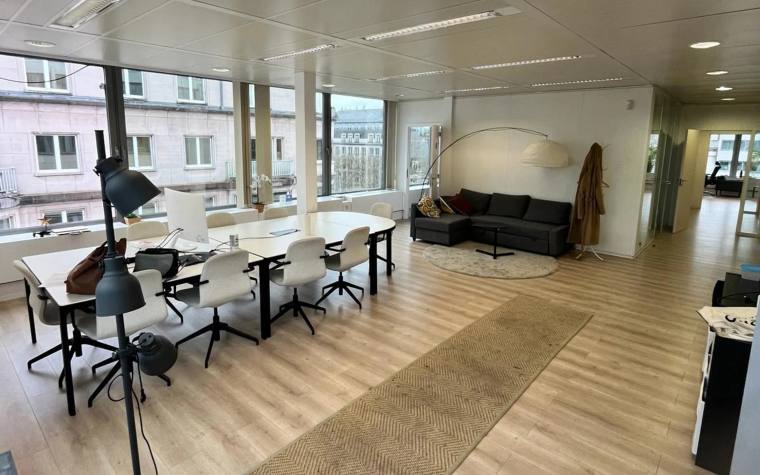
Brussels Office Leases: Flexibility Clauses to Discuss in 2026
Term, exit options, works and move-in date: the clauses to clarify before signing an office lease in Brussels.

A commercial lease is a rental contract whereby the landlord and the tenant expressly or implicitly agree to use the premises for a retail commercial or craft activity with direct access to the public. Places such as shopping centres or stores without free access for customers are excluded from this definition.
The commercial lease is governed by the Law of 30 April 1951, as well as Articles 1708 to 1768bis of the Civil Code.
A commercial lease typically runs for 9 years, renewable up to 3 times for a maximum total of 36 years.An exception exists for short-term leases, such as a pop-up store, which can run for up to 1 year. If no notice is given at the end of this short lease, it automatically converts into a standard 9-year commercial lease.
Depending on the clauses of the contract, either the landlord or the tenant may be responsible for registering the lease. In practice, this obligation usually falls on the tenant.Registration must take place within 4 months of signing the lease, and the fee is 0.2% of the total rent and charges over the contract duration, with a minimum of €50.This gives the contract a fixed date, making it enforceable against third parties.
The tenant must request renewal of the lease within a specific period, namely between the 18th and 15th month before the end of the contract, by bailiff or registered mail.This request must include the legal references, specifically Article 14 of the Commercial Lease Act, which stipulates that if the landlord does not respond within 3 months, the renewal is deemed accepted.
If the tenant fails to make this request on time, only the landlord will decide whether or not to extend the contract.
The tenant may terminate the lease early at the end of each 3-year period, by giving 6 months’ notice.The landlord, for his part, can terminate the lease with 12 months’ notice, provided this is stipulated in the contract and only for specific legal reasons.
The landlord may also refuse renewal for legally recognized reasons, which may lead to compensation depending on the grounds invoked.
If, at the end of the lease, the tenant continues to occupy the premises without opposition from the landlord, the contract becomes an indefinite-term lease.The tenant may then terminate it with 1 month’s notice, while the landlord must give 18 months’ notice. The tenant can still request renewal within the 18 to 15 months period of this notice.
Rent indexation, if provided for in the contract, applies retroactively over a 12-month period, allowing the rent to be adjusted in line with inflation.
| Element | Applicable rules in Belgium |
| Minimum duration | Commercial lease for at least 9 years; any shorter duration is requalified (pop-up < 1 year). |
| Short-term lease | Pop-up store up to 1 year; beyond that, automatically becomes a 9-year lease. |
| Renewals | Renewable up to 3 times, for a maximum of 36 years, without notarial formalities. |
| Tenant termination | Possible at the end of each 3-year period, with 6 months’ notice (bailiff or registered letter). |
| Landlord termination | Possible at the end of each 3-year period, with 12 months’ notice, only for legal reasons (personal use, family, etc.). |
| Tenant renewal request | Must be made between 18 and 15 months before lease end, by bailiff or registered mail. |
| Silence of landlord | If no reply within 3 months, renewal is deemed accepted. |
| Registration | Mandatory within 4 months of signing, at 0.2% of total rent, minimum €50. |
| Tacit continuation | If tenant stays without objection, lease becomes indefinite (notice: tenant 1 month, landlord 18 months). |
| Rent indexation | Possible if provided in the lease, usually annual based on inflation (CPI). |
The law sets the term and the renewal rules, but the content of the lease decides whether the location will work for your business. Before signing, take the time to check these points.
Planning use: the planning permission for the unit must allow your activity. A former office does not become a shop or a restaurant without a change of use, and that procedure takes time.
Charges and guarantee: ask for the breakdown of service charges, who pays the property tax and what form the guarantee takes. These lines often weigh as much as the rent difference between two locations.
Works: who pays for the fit-out, who covers major repairs and what condition will you have to leave the premises in? A vague reinstatement clause can be expensive at the end of the lease.
Assigning the lease: the law lets you assign your lease together with your business, and the landlord can only refuse for legitimate reasons. Check that the contract does not add conditions that would make a future sale difficult.
Exclusivity and non-compete: in a shopping arcade or mixed-use building, ask whether a direct competitor could open next to you, and what the lease forbids you in return.
Real footfall: visit the unit at different times of day. The flow of customers past the window matters more than a prestigious address.
The commercial lease, with its complex rules and legal implications, requires careful attention. Navigating the intricacies of the commercial lease law can be challenging for the parties involved. It is highly recommended to seek the services of a real estate agent specialized in commercial leases to avoid costly mistakes.Their expertise can be essential to ensure a smooth transaction that complies with current laws.

A commercial lease is generally concluded for a period of 9 years. It can be renewed up to three times, for a maximum total of 36 years. For temporary activities such as a pop-up store, a short-term lease (maximum 1 year) is possible.
Yes. The tenant can terminate the lease at the end of each 3-year period, with 6 months’ notice. The landlord may also terminate, but only for specific legal reasons, with 12 months’ notice.
The tenant must request renewal between 18 and 15 months before the end of the lease, by bailiff or registered letter. If the landlord does not respond within 3 months, the renewal is deemed accepted.
If the tenant remains on the premises without objection from the landlord, the lease becomes an indefinite-term lease. It may then be terminated by the tenant with 1 month’s notice, or by the landlord with 18 months’ notice.
Yes, registration is compulsory within 4 months after signing the lease. The registration fees are 0.2% of the total rent, with a minimum of €50.
No, it must be provided for in the contract. Generally, rent is indexed annually based on inflation (health index).
Commercial leases are governed by strict rules. A specialized real estate agent will help you avoid mistakes, secure your investment, and optimize your lease conditions.
Turn this insight into a practical search by browsing available office spaces in Brussels with their sizes and locations.
Related articles
→ How to successfully negotiate your commercial lease as a freelancer in Brussels
→ Common Law Lease in Belgium: Flexibility, Differences and Key Points to Watch
Term, exit options, works and move-in date: the clauses to clarify before signing an office lease in Brussels.

Learn how to start a business in Brussels, the steps and timelines involved, and which type of office suits freelancers, startups, and SMEs.

Learn about EPC NR requirements in Flanders from 2025 for non-residential buildings over 1,000 m². Key deadlines, labels and tips for owners and investors.