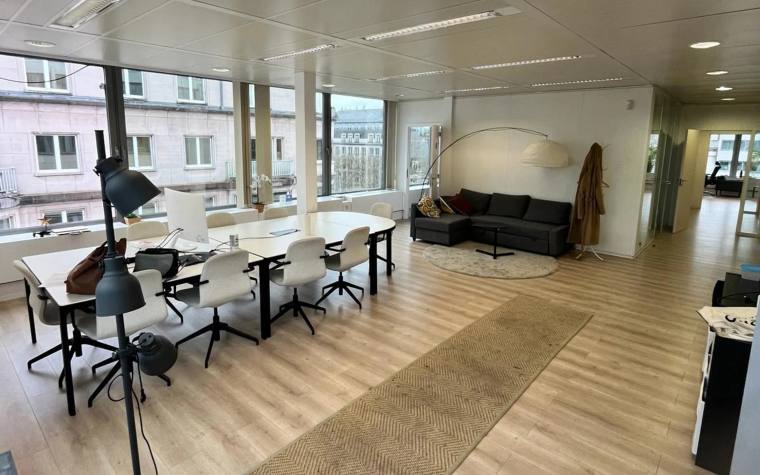
Brussels Office Leases: Flexibility Clauses to Discuss in 2026
Term, exit options, works and move-in date: the clauses to clarify before signing an office lease in Brussels.
Legal and regulatoryESG Certifications and Standards

The Flemish region is firmly committed to achieving carbon neutrality, introducing increasingly strict regulations to improve the energy performance of buildings. After targeting the residential sector, it’s now the turn of the non-residential real estate market (offices, shops, logistics sites, hotels, etc.).
Starting January 1, 2025, the EPC NR certification (Energy Performance Certificate for Non-Residential Buildings) will become mandatory for all large units with a usable floor area of 1,000 m² or more. This marks a gradual but firm shift, requiring many property owners to reassess the efficiency of their assets.
The goal of the EPC NR certificate is twofold:
In practice, the EPC NR assigns an energy label to a building, summarising its performance. It’s a tool that will gradually steer the market toward better-insulated properties equipped with more efficient, low-carbon systems.
The EPC NR certificate has already been required when:
This ensures any new owner or occupant is immediately informed.
All non-residential units with a usable floor area of at least 1,000 m² must have a valid EPC NR certificate, even if there is no change of ownership or tenant. This is a major milestone, introducing a broad structural obligation.
A year later, this obligation will extend to smaller non-residential buildings, under 1,000 m². Thus, the entire non-residential real estate market will progressively be covered.
Starting in 2028, large public buildings (administrative and collective infrastructures) must not only have an EPC NR certificate but also achieve at least an energy label “E”. Since 2024, these buildings are already required to hold an EPC NR, replacing the old EPC Public.
From January 1, 2030, all non-residential buildings, regardless of size, must reach at least an “E” label. Simply possessing a certificate will no longer suffice; owners must prove their building’s effective performance.
These developments mark a decisive moment for the real estate market in Flanders, offering both opportunities and significant challenges.
Many buildings will require renovations to achieve an acceptable energy label: upgrading roof and façade insulation, installing more efficient HVAC systems, switching to LED lighting or adding photovoltaic panels are often unavoidable.
Owners who plan ahead can spread their investments over time, avoid last-minute rush projects in 2029, and keep control of costs. For investors, a poor energy score may deter tenants or lower resale value. Conversely, strong energy performance can become a powerful selling point and help maximise the property’s long-term value.
To stay compliant and competitive, property owners and real estate managers are strongly advised to:
The EPC NR certification is a key instrument pushing the non-residential building stock toward standards aligned with climate goals. Starting in 2025, large surfaces over 1,000 m² in Flanders will be directly impacted, followed by a gradual extension to the entire sector.
From 2030, achieving at least an “E” label will be mandatory for all non-residential buildings. Preparing now ensures owners can protect their asset values, control costs, and actively contribute to the vital energy transition.
The EPC NR (Energy Performance Certificate for Non-Residential Buildings) assesses the energy performance of non-residential buildings in Flanders. It informs owners, investors and tenants about energy efficiency levels and encourages upgrades to reduce consumption and emissions.
Starting January 1, 2025, all non-residential buildings in Flanders with a usable floor area of 1,000 m² or more must have a valid EPC NR certificate.
From January 1, 2026, the requirement will also apply to non-residential buildings under 1,000 m². From 2030, all such buildings must achieve at least an energy label “E”.
Beyond possible administrative penalties, a building without a certificate or with an insufficient label may lose market value or deter buyers and tenants who care about energy efficiency.
They can commission an energy audit to identify priorities, plan the necessary renovations, take advantage of regional grants, and work with tenants to optimise building use and reduce waste.

For advice on the location and premises that suit your business, contact our team.
Related articles
→ Energy performance certificate for commercial buildings in Belgium
Term, exit options, works and move-in date: the clauses to clarify before signing an office lease in Brussels.
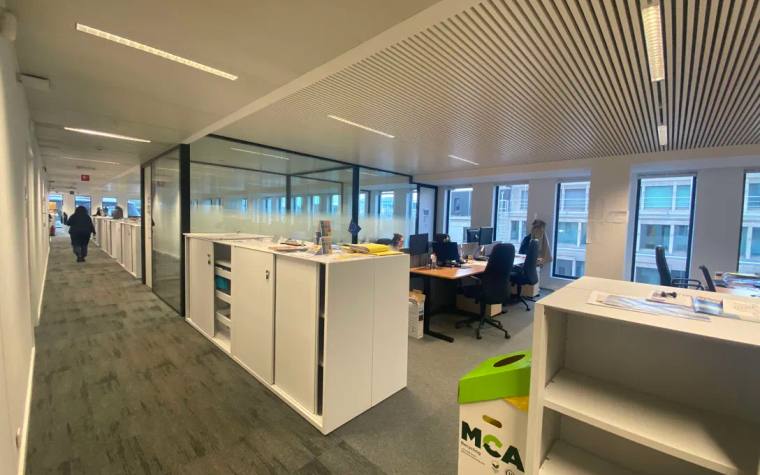
A label is not enough: check ventilation, comfort, charges and energy data when viewing an office in Brussels.

Learn how to start a business in Brussels, the steps and timelines involved, and which type of office suits freelancers, startups, and SMEs.